Blind to Collapse: The Negligence of Bitcoin Maximalists — A Crisis Article by PARTiCLUS
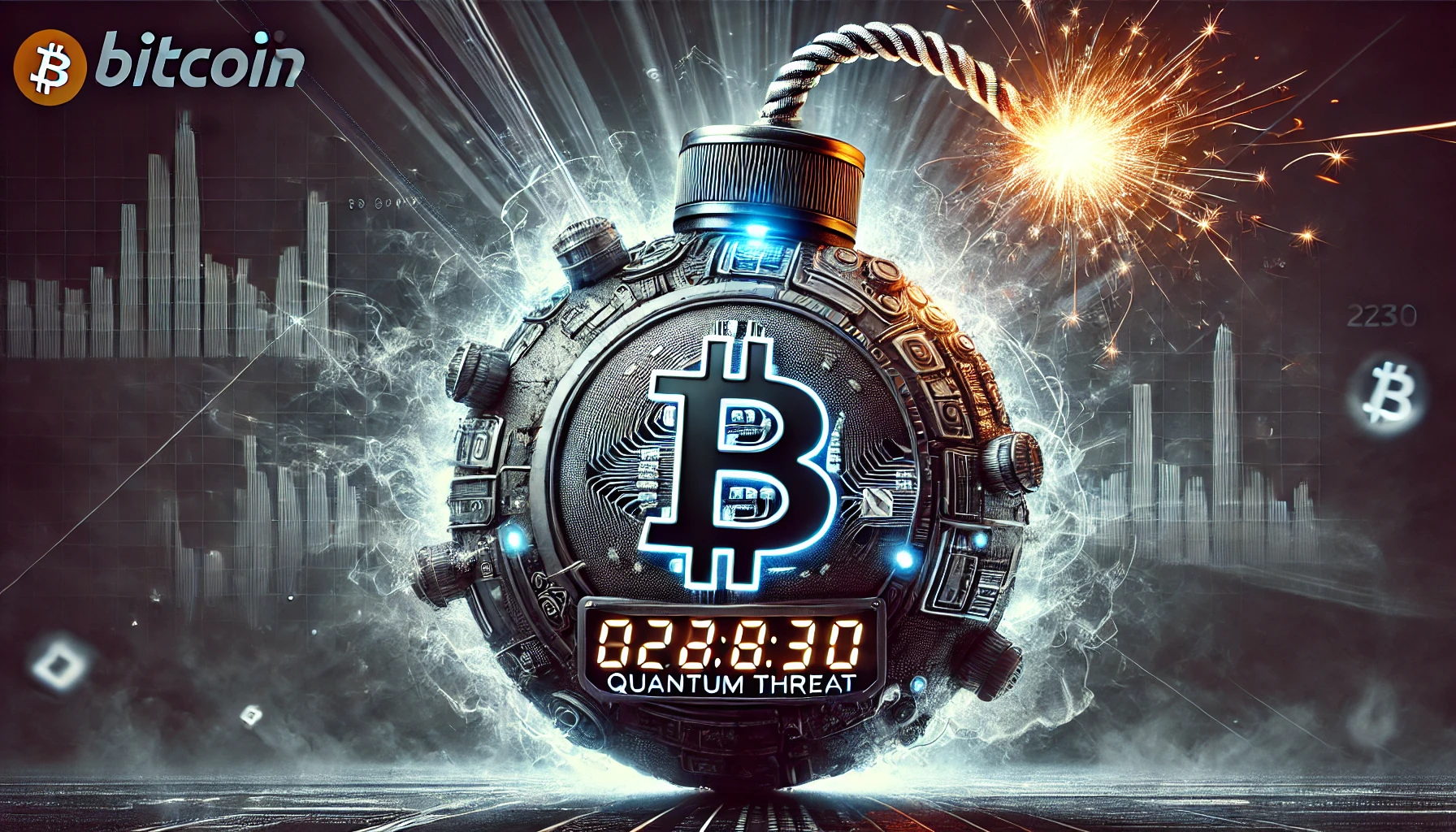
Look, Bitcoin’s had a good run—nobody’s denying that. But its days as the untouchable king of crypto are numbered, and the writing’s on the wall. The negligence of Bitcoin Maximalists is clearer than ever. Quantum computing isn’t some sci-fi pipe dream anymore; it’s barreling toward us faster than anyone expected, ready to crack blockchain’s foundations wide open. And yet, you’ve got these Bitcoin diehards—the maximalists—who act like plugging their ears will make the problem disappear. They’re wrong, and it’s starting to get risky.
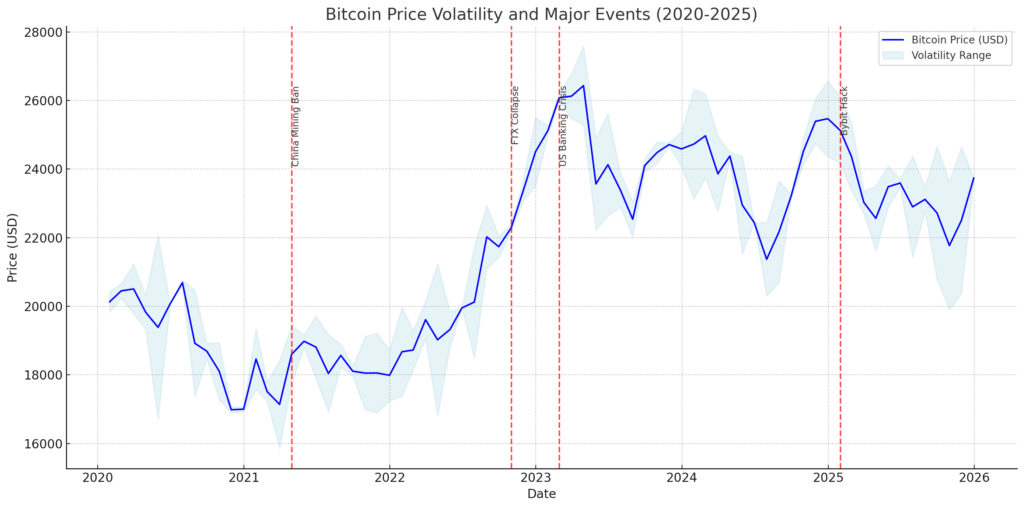
This Crisis Article isn’t here to sugarcoat things: quantum tech is a real threat, right now, and it could sink Bitcoin’s whole “unbreakable” vibe. Just look at the Bybit mess—$1.5 billion gone in 2025 because blockchain’s already buckling under today’s cyberattacks. That’s where PARTiCLUS comes in, waving the flag for Vertisan (VTSN) and Fractal. These aren’t just shiny new toys or some modifications or existing tech; they’re built from the ground up, by Satoshi himself, to handle whatever the quantum age throws at them—flexible, tough, and actually decentralized, not just pretending to be. I’m going to dig into why Bitcoin’s cheerleaders are missing the point, bust the myth that it’s invincible, and lay out a no-nonsense plan to get ahead of this mess. Governments, big investors, regular folks—if you’re smart, you’ll listen up. Waiting’s not an option anymore.
Bitcoin’s Glory Days Are Slipping
Back in 2009, Bitcoin felt like a revelation. No banks, no suits calling the shots—just a clean, decentralized system humming along on cryptography we thought was bulletproof. That 21 million coin cap? Genius. The blockchain, locked tight with SHA-256 and ECDSA? A fortress. For a while, it really seemed like nothing could touch it.
Then quantum computing rolled in and flipped the table. Microsoft’s Majorana 1 chip isn’t a “maybe someday” thing—it’s here, and it’s a game-changer. People smarter than me say stuff like Shor’s Algorithm could gut Bitcoin’s security in a handful of years, leaving wallets wide open and billions up for grabs. As quoted by Microsoft, “It leverages the world’s first topoconductor, a breakthrough type of material which can observe and control Majorana particles to produce more reliable and scalable qubits, which are the building blocks for quantum computers.”
But talk to a Bitcoin maximalist, and you’d think I’m making it up. They’re so dug in, they can’t—or won’t—see what’s coming. That’s not just stubborn; it’s dangerous… or maybe just manipulative in order to protect their own interests.
Here’s the pitch you’ve heard a million times: Bitcoin’s got this hard limit—21 million coins, no more, ever. It’s the rock they’ve built their church on, the thing that’s supposed to keep it steady while everything else goes haywire.
Except it’s not that simple anymore. Even heavy hitters like BlackRock have kicked around the idea of tweaking that cap. Sure, pulling it off would mean getting everyone to agree in Bitcoin’s messy, decentralized world—good luck with that they say—but the fact it’s even on the table shows the cracks forming, and really all they need to do is control or convince the core group of developers. And then there’s the slow bleed: every halving cuts the rewards for miners, and if they start bailing, the network’s security takes a hit. Some folks are quietly asking, “Hey, maybe we bump the supply to keep things running?” Sacrilege to the purists, but it’s not crazy talk—it’s happening in real conversations. Point is, “forever untouchable” isn’t looking so forever anymore.
Quantum’s Not Waiting Around
This quantum stuff? It’s not a hunch—it’s math, and the math doesn’t lie. These new machines, like the ones playing with Majorana qubits, are on track to shred the cryptography Bitcoin leans on. It’s not about “if” anymore; it’s “when.”
The proof’s piling up:
- Bybit, 2025: $1.5 billion stolen by the North Korean Lazarus Group exploiting vulnerabilities in Ethereum’s cold wallet storage.
- Mt. Gox: Remember that disaster? A catastrophic failure that resulted in the loss of 850,000 BTC, exposing centralized exchange weaknesses and Bitcoin’s reliance on traditional legal frameworks for remediation.
- The DAO: A landmark incident that drained $60 million in Ether, highlighting flaws in Ethereum’s smart contract code and illustrating blockchain’s need for centralized intervention despite claims of decentralization.
- Harvest Now, Decrypt Later Attacks: Cybercriminals are already stockpiling encrypted blockchain data in anticipation of future quantum breakthroughs capable of decrypting it.
These aren’t flukes—they’re red flags. We’re kidding ourselves if we think Bitcoin’s ready for what’s next.
Trust? More Like a Trust Fall
Blockchain’s big sell was always “no middleman needed.” You and me, trading straight up, with the code keeping it honest. Sounds great—until it doesn’t work. The TRUST BUT VERIFY piece by Angela Walch laid it bare: In reality, blockchains still require trust in human actors, particularly software developers and miners/validators. Walch argues that this discrepancy between perception and reality creates risk for users, investors, and the financial system.
For Bitcoin, that’s a gut punch. All that talk about cutting out the system, and it still ends up needing a judge to sort out the mess. Trustless? More like trusting the old ways when the chips are down.
Vertisan & Fractal: The Fix We Need
PARTiCLUS isn’t just about griping—I’m bringing answers. Vertisan (VTSN) and Fractal are the real deal:
Vertisan (VTSN) and Fractal represent the next evolutionary leap in decentralized finance:
- Quantum-Resistant Cryptography: Designed to withstand quantum attacks using advanced post-quantum encryption standards, preventing quantum computing from exploiting cryptographic vulnerabilities.
- Adaptive Consensus Mechanisms: Evolving protocols capable of upgrading dynamically without disruptive hard forks, allowing for continuous improvements as quantum technology advances.
- Self-Regulating Trust Models: Eliminating reliance on outdated legal structures by embedding governance directly into the code—providing real-time consensus adaptations.
- Legit Coin Cap: Hard-baked via a Sovereign Entity Protocol https://vtsn.org/sovereign-entity-protocol.
This isn’t a Band-Aid for Bitcoin—it’s a whole new playbook.
Governments Must Abandon Bitcoin: A Policy Imperative
National governments have a responsibility to safeguard their economies from systemic financial collapse. Bitcoin’s inherent vulnerabilities, especially in the face of quantum disruption, make it a dangerous asset for national reserves.
By supporting quantum-resistant technologies like Vertisan, governments can:
- Protect digital economies from cyber threats.
- Foster innovation in post-quantum financial infrastructure.
- Develop robust regulatory frameworks that encourage long-term stability rather than speculative bubbles.
- Eliminate reliance on outdated systems vulnerable to both legal manipulation and quantum decryption.
The IMF’s been crunching the numbers: Bitcoin’s ups and downs mess with 14-18% of stock market chaos and 8-10% of returns. If it crashes hard, it’s not staying in crypto—it’s spilling everywhere. Time to wise up.
This significant correlation suggests that a severe downturn in the cryptocurrency market could have ripple effects across traditional financial systems.
The European Central Bank (ECB) has also highlighted the risks associated with the high volatility of crypto-assets. In a market downturn, the value of these assets can plummet rapidly, potentially leading to liquidity crises as borrowers are forced to post additional collateral or face liquidation.
Such scenarios underscore the precarious nature of financial systems heavily exposed to volatile crypto-assets.
Moreover, the interconnectedness between cryptocurrency markets and traditional financial institutions has grown. As more banks and investment firms engage with crypto-assets, the potential for systemic risk increases. The IMF warns that the increased co-movement between crypto and equity markets could pose risks to financial stability, especially in countries with high levels of crypto adoption.
The negligence of Bitcoin maximalists is no longer a harmless ideological stance—it’s a systemic risk to the future of decentralized finance. This Crisis Paper serves as both a warning and a blueprint: Pivot to quantum-resistant technologies now, or face inevitable collapse.
PARTiCLUS is not just observing this transformation—the goal is to lead it.
The future belongs to those who prepare for it. Vertisan and Fractal are that future.
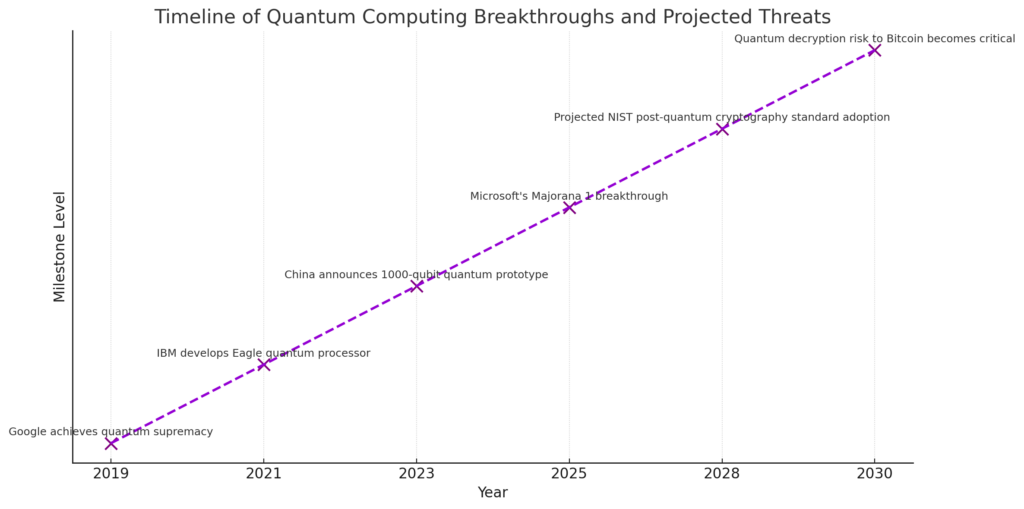
Timeline illustrating key quantum computing breakthroughs and projected threat levels to blockchain security. It highlights pivotal moments like Google’s quantum supremacy, Microsoft’s Majorana 1 breakthrough, and the anticipated quantum decryption risk to Bitcoin by 2030.
NIST vs Fractal
The quantum resistance offered by NIST’s (The National Institute of Standards and Technology) post-quantum cryptographic standards versus the inherent security of Vertisan and Fractal represents two fundamentally different approaches to securing digital systems against quantum threats.
NIST’s Post-Quantum Cryptographic Standards (FIPS 203-205)
These standards build on classical cryptography by introducing mathematically complex problems (like lattice-based, hash-based, or multivariate polynomial cryptography) that are believed to be difficult for quantum computers to solve.
They provide quantum-resistant upgrades to existing blockchain, encryption, and digital signature algorithms to future-proof current cryptographic infrastructure.
- Limitations:
- Still built on traditional encryption paradigms (i.e., public-key cryptography).
- Requires migration of existing systems to these new algorithms—an expensive and time-consuming process.
- May still be vulnerable to future quantum algorithm breakthroughs beyond Shor’s or Grover’s algorithms.
Vertisan and Fractal’s Native Quantum Resistance
Unlike NIST’s efforts, Vertisan and Fractal aren’t based on blockchain or traditional encryption algorithms. They use entirely new data structures and consensus mechanisms that don’t rely on solving computational problems susceptible to quantum attacks.
- Since Vertisan and Fractal don’t use blockchain or traditional key-pair cryptography, quantum computers have nothing to “break” in the first place:
- No reliance on public-key infrastructure (PKI).
- No dependence on computational hardness assumptions vulnerable to quantum attacks.
- Fractal’s Design Advantages:
- Designed from the ground up to bypass blockchain limitations, including the vulnerabilities that quantum computers would exploit.
- Its architecture is immune to the quantum advantage that threatens Bitcoin, Ethereum, and other blockchain-based systems.
| Feature | NIST Post-Quantum Standards | Vertisan & Fractal |
| Technology Base | Blockchain, Public-Key Cryptography | Fractal-based (Non-blockchain) |
| Quantum Resistance Strategy | Mathematical complexity (e.g., lattice-based) | Native resistance (No attack surface) |
| Migration Needs | Requires transition from existing systems | No transition needed, quantum-proof by design |
| Scalability | Limited by blockchain’s performance issues | Scales more efficiently, free from blockchain constraints |
| Attack Surface | Present (key-pair systems still exist) | Minimal or nonexistent due to design |
| Long-Term Viability | Vulnerable if future quantum algorithms improve | Future-proof unless new theoretical flaws are discovered |
So what does all this really mean?
NIST’s Standards are a necessary patch for existing blockchain and encryption systems but represent an evolutionary rather than revolutionary step.
Vertisan and Fractal represent a complete paradigm shift, offering intrinsic quantum resistance by eliminating traditional cryptographic vulnerabilities altogether.
In simple terms: NIST’s standards protect outdated infrastructure from quantum threats, while Vertisan and Fractal create an entirely new playing field where quantum attacks aren’t even relevant.