Vertisan’s AMM: Redefining the Foundations of Decentralized Market Infrastructure
Introduction
The evolution of decentralized finance (DeFi) has been marked by both rapid innovation and recurring structural weaknesses. While early Automated Market Makers (AMMs) such as Uniswap introduced groundbreaking mechanisms for peer-to-peer asset exchange, they also exposed vulnerabilities around slippage, manipulation, and liquidity instability.
VERTISAN’s Automated Market Maker (AMM) represents a significant advancement beyond these earlier models — offering a mathematically rigorous, dynamically balanced framework for decentralized market operations.
A New Model for Price Formation and Liquidity Stability
Unlike traditional order book systems, where discrete bids and asks determine price discovery, VERTISAN’s AMM operates on a foundation of continuous, real-time equilibrium recalculation.
Following each trade, the AMM algorithm rebalances the relationship between assets, maintaining systemic equilibrium through:
- Continuous monitoring of all asset balances within the liquidity pool
- Application of a dynamic constant (K) and depth parameter (D) to preserve fair ratios
- Instantaneous price recalibration across the pool after each transaction
- Intrinsic resistance to single-trader manipulation or coordinated attacks
The core design principle is straightforward: The more pressure applied to distort market balance, the more robust the algorithmic counterforce becomes.
This creates a resilient pricing environment that rewards honest participation while disincentivizing exploitative behavior.
Strategic Significance: Why This Advancement Matters
Most legacy AMMs, such as those used by Uniswap and Balancer, rely on relatively simple invariant functions (e.g., x*y=k). While functional, these models are susceptible to inefficiencies under high volatility, significant volume spikes, or asymmetrical liquidity contributions.
VERTISAN’s model introduces critical improvements:
- Greater market stability
- Deeper liquidity efficiency
- Structural resistance to known exploit vectors, including front-running and flash loan attacks
- Scalable architecture suitable for multi-asset pools and complex trading ecosystems
As DeFi transitions into a more mature phase, infrastructure sophistication — not merely transactional speed — will be the primary driver of ecosystem growth. VERTISAN’s AMM directly addresses this need.
Technical Analysis: Solving Legacy AMM Limitations
VERTISAN’s AMM systematically addresses deficiencies long recognized in earlier DeFi architectures:
- Mitigation of price slippage attacks
- Market stabilization under volatile conditions
- Prevention of front-running and sandwich trade manipulation
- Efficient liquidity utilization without relying on external price oracles
The algorithm synthesizes insights drawn from successful precedents — notably Curve’s StableSwap and Balancer’s multi-asset pools — while eliminating reliance on fragile third-party pegs, as seen in failed experimental models like Terra’s.
Its distinction lies in the direct internal anchoring of liquidity dynamics, rather than external dependencies.
System Strengths
- Fairness: Dynamic rebalancing ensures that no individual participant can meaningfully distort market conditions without incurring significant cost.
- Stability: Volatility is absorbed and rebalanced at each trade event, minimizing systemic distortions over time.
- Liquidity Efficiency: Capital is dynamically adjusted across the pool, avoiding stagnant reserves or capital misallocation.
- Manipulation Resistance: Non-linear adjustment factors and constant recalibration substantially increase the cost of exploit attempts.
- Scalability: Architecture supports multi-asset liquidity pools without introducing systemic fragility.
Critical Risks and Strategic Considerations
Complexity and Market Education: The advanced mathematical framework introduces a steeper learning curve for participants accustomed to simplistic AMM models. However, market sophistication is increasing, and this education gap is likely to narrow over time.
Computational Demand: Iterative recalculations imply a heavier computational load compared to first-generation AMMs. This is mitigated through VERTISAN’s fee model, where transactions are settled with Dark Energy Units (DEUs) at a negligible cost.
Adoption Lag: Being structurally superior does not guarantee immediate adoption. Nevertheless, the value proposition for larger pools and institutional-grade liquidity providers is compelling.
Mathematical Framework Overview
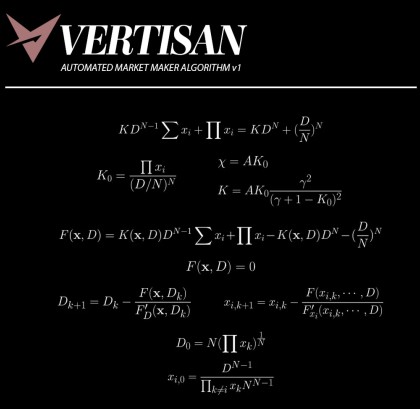
Reserve Balancing:
KD^(N-1) Σxᵢ + ∏xᵢ = KD^N + (D/N)^N
Base Multiplier:
K₀ = (∏ xᵢ) / (D/N)^N
Adjustment Functions:
χ = AK₀
K = AK₀(γ² / (1 - K₀)²)
Market Rebalancing:
F(x, D) = K(x, D) D^N Σxᵢ - K(x, D) D (D/N)^N
Iterative Depth Updates:
Dₖ₊₁ = Dₖ - (F(xₖ, Dₖ) / F'_D(xₖ, Dₖ))
Initial Pool Setup:
D₀ = N(∏ xᵢ)^(1/N)
xᵢ₀ = D^(N-1) / (∏(xₖ ≠ xᵢ)√(N-1))
Strategic Conclusion
VERTISAN’s Automated Market Maker does not simply improve decentralized trading efficiency — it lays the groundwork for a fundamentally more resilient financial architecture.